


Top Guide Plate
30mm
Galvanised
Price:£18.07
A sliding gate needs a guide near the top to keep it upright and running in line. Both tracked and cantilever gates use top guides. Choose one to suit the shape of your gate and where you can fix the bracket, rather than the type of running gear beneath it.
For a flat-topped gate without finials, an adjustable guide that fits over the top is often the simplest route. If the gate has a curved top or finials, a roller can run in a C-shaped channel fixed behind the gate instead. This page is for complete guide brackets and assemblies; if you need a separate roller or channel, see guide rollers and channels.


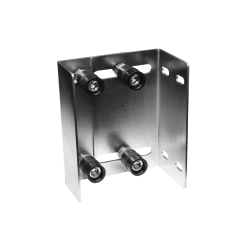
Many guides allow adjustment so the gate can be aligned after fitting. Check the dimensions and fixing arrangement of the particular product before ordering; not every bracket has the same range of adjustment.
Choose a complete guide here if you need the bracket and roller arrangement for a new gate, or if the existing bracket also needs replacing. If your bracket is sound and only a roller or channel is needed, go to individual guide rollers and channels.
For a replacement roller, measure the nylon roller's diameter and length and the axle bolt's metric thread size (the M size). Compare the mounting and current product drawing too; a roller with the right diameter alone may not fit the existing bracket.
No. The top guide keeps the gate upright and aligned; it does not replace the parts that carry its weight. A tracked gate runs on wheels and ground track. A cantilever gate uses cantilever support hardware. Both still need a suitable upper guide.
If a gate is leaning or dragging, ask an installer to check the supporting parts and alignment before assuming a new top roller will fix it.
Email Metalines a photo of the gate's top or rear channel, the post or pier where the guide will fix, and any measurements or existing product reference. We can help select suitable equipment from the information you provide; we do not carry out site work.