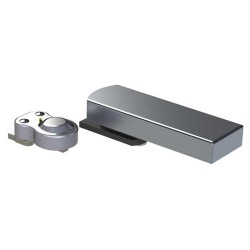
APSW replaces the lower hinge, so the existing hinge arrangement must be changed and the top and bottom pivots aligned. PANTHER mounts above the gate in suitable wall-and-post layouts; check the recommended gate stop too. Compare their drawings with your gate before choosing.
A new metal gate whose hinges and closer can be planned together
This weld-on hydraulic closer is part of the hinge arrangement and lets you adjust closing and final-latching speed. Standard APS needs a separate opening stop; APSSTOP has an integral 90° stop. Plan the stop with the frame.
GSB uses weld-on brackets; GSBW is screw-fixed. Their bracket position changes the closing force. A loose gas spring is a different purchase from a closer arrangement.
Start here if bringing the gate shut matters more than adjustable hydraulic closing speed.
Will a closer stop the gate slamming?
If you want the gate to close at a controlled speed, start with a hydraulic model and compare its speed settings and fitting diagram. A spring return may pull the gate shut without slowing its movement in the same way. Closing speed, the final movement into a latch and the force needed to move the gate are different things; tell us which problem you are trying to solve.
A closer works best on a gate that already swings freely and lines up with its post. If the gate drags or the latch misses its keep, the hinges or alignment need attention too. The closer brings the gate back; a latch or lock provides the catch or locking action you want when it reaches the post.
What measurements help you choose?
Measure the gate width and estimate its finished weight. Photograph the hinges and both sides of the gate and post, including the gap when the gate is closed. Tell us whether it opens inwards or outwards, how far it should open, and whether it is used occasionally or many times a day. For a school or other busy pedestrian gate, tell us how you need it to close as well. If you already have a closer, its full model reference and photographs will help us match a replacement.
For a heavy or frequently used gate, the right choice depends on more than a headline weight figure. The gate's hinge layout, fixing surfaces, opening angle and desired closing behaviour all matter. Send us the details and we can narrow down suitable equipment.
Do you need a complete closer or a part?
The product grid also contains an industrial support gas spring, release tools, a latchbolt and fixing kits. These do different jobs and are not complete gate closers. If you need a replacement part for a closer, send us the closer reference and a photograph of the piece in place; we can help identify the matching component. For ordinary hinges without a self-closing mechanism, browse gate hinges and fittings.