Start with the hinge position, not just the pillar size
Two gates on equally wide pillars can need very different operators when their hinges sit in different positions. The hinge centre in relation to the post faces, the available mounting space and nearby walls or obstacles are all useful. Measure the left and right sides separately, as even a matching pair of gates may not be perfectly symmetrical.
Which measurements and photographs will help?
- The whole entrance: a clear view of both gates and posts, showing which side is inside the property.
- Each leaf: width, approximate weight, material or infill, and whether it is already hung.
- Each hinge and post: post width, hinge position and the distances shown on the matching survey drawing. A close view of the hinge and adjacent post faces is especially useful.
- Opening space: the direction and angle you need, walls or other obstacles, and any slope across or through the entrance.
- How the gate will be used: expected daily use, busy periods, wind exposure, power location and existing equipment references if this is a replacement.
Please use millimetres for the geometry fields and label the left and right sides as viewed from outside, following the survey. If a detail is unknown, say so rather than entering zero. Photographs help us understand the layout, while the dimensions allow a model-specific comparison. Only collect information that can be reached safely; there is no need to move or dismantle an unsafe gate.
Are articulated-arm openers the answer for every large pillar?
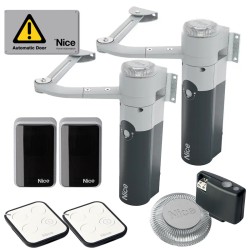
They are one useful option, but the arm still needs enough room to move. For example, Nice's HYKE instructions show full-length and reduced-length arm arrangements and relate the mounting positions to opening angle. The hinge position and available movement tell us more than the pillar width alone.
Can a linear gate ram work instead?
It can be an option when the model's mounting geometry and operating limits suit the entrance. CAME's ATS range, for example, publishes a C-dimension limit as well as several operator variants. We use the drawing for the exact model rather than assuming that every telescopic ram will suit every deep post.
Does a C-dimension tell me everything I need?
No. A quoted maximum only makes sense alongside that manufacturer's drawing and the other installation dimensions. Different manuals may use A, B or C for different measurements, so send us the actual geometry rather than relying on a letter alone. The mounting drawing for the selected model is the reference we will use.
Would an underground motor avoid the pillar problem?
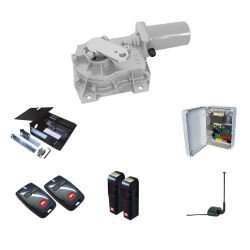
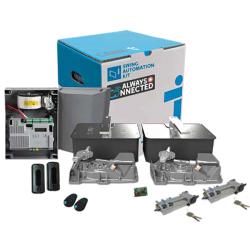
It changes the mounting arrangement and may be worth considering, but the hinge axis, foundation-box position, drainage and access still matter. Our underground-kit guide explains the package, box and release choices so you can compare that approach properly.
What if the driveway slopes or the gate must open outwards?
Show the direction of the slope, the way the gate needs to open and any nearby obstruction. The gate still needs a clear swept area whichever operator is chosen. Rising hinges, outward opening and unusually wide angles need an arrangement that is specifically supported for the selected equipment, so include them in your enquiry from the start.
What if the gates are not built yet, or I cannot provide every dimension?
That is fine. Tell us the gates are still at the planning stage and send what you know about the entrance layout, proposed leaf dimensions, hinge arrangement and opening requirements. We can explain which missing details will be needed before the equipment choice can be confirmed.
What happens after I send the site information?
We use the survey details you provide to help specify suitable equipment and will come back to you if a measurement or proposed arrangement needs more information. We supply and specify equipment; we do not carry out site visits, installation or on-site repairs.
A workable mounting arrangement is one part of a safe finished system. HSE's powered-gate guidance explains why the complete gate, its surroundings and its ongoing maintenance all matter. If you need to replace the physical hinges rather than automate the gate, see our gate hinges and fittings.