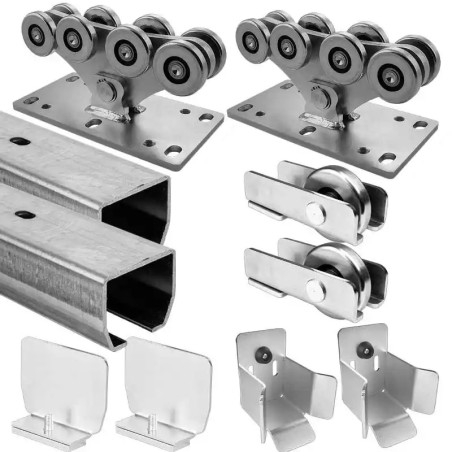
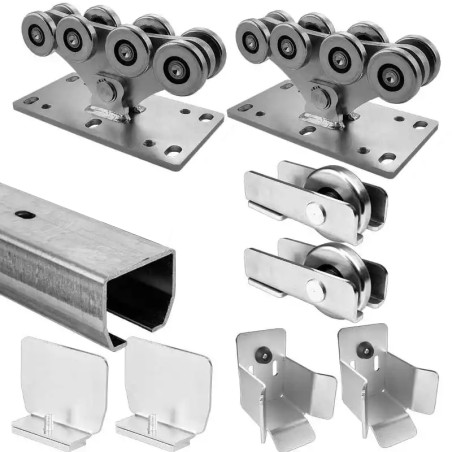
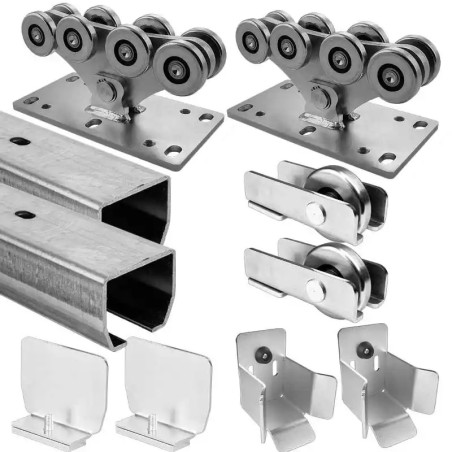
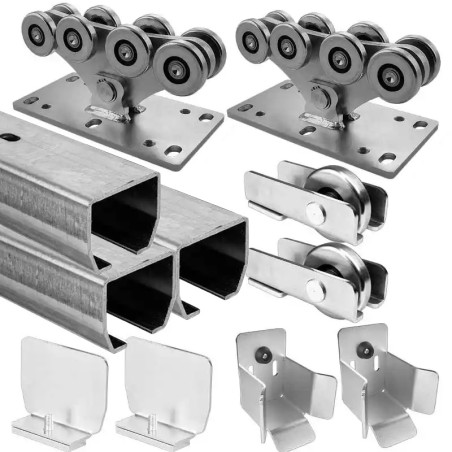
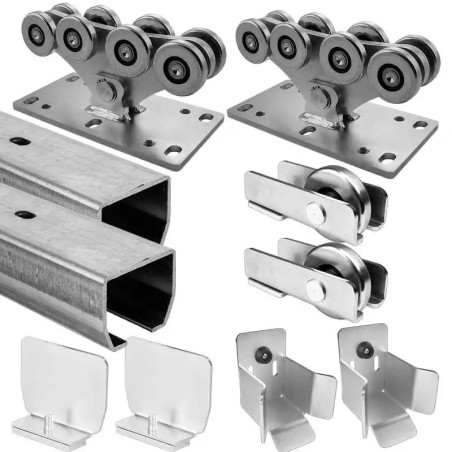
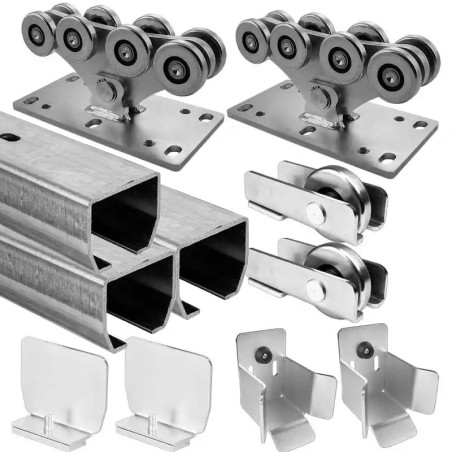
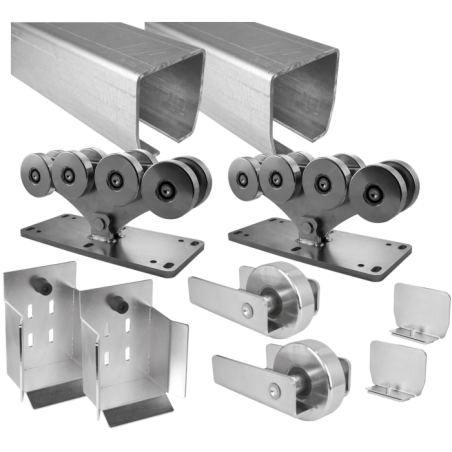
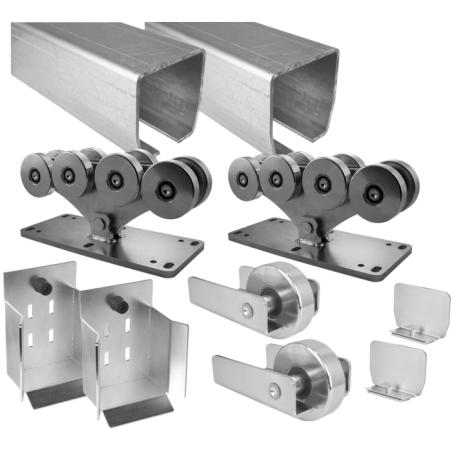
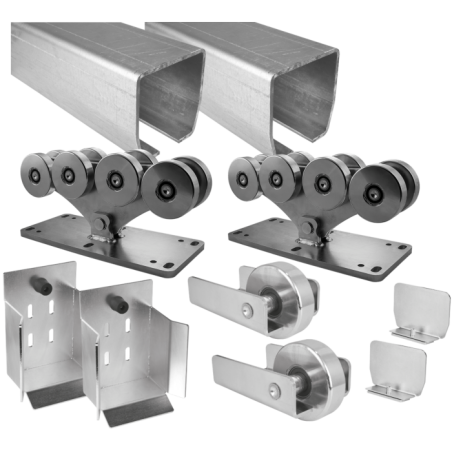
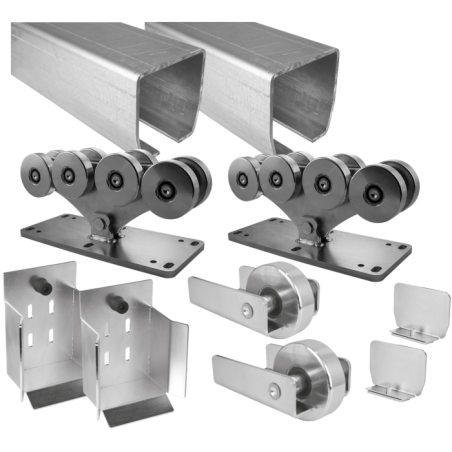
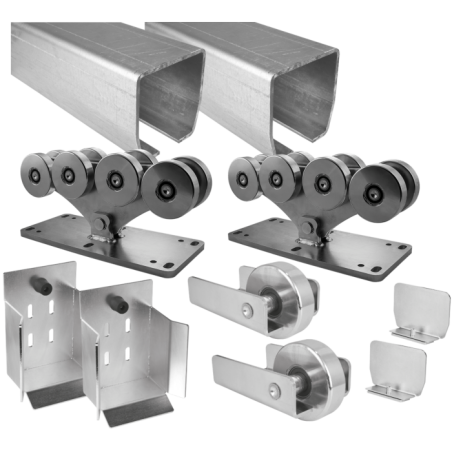
Which cantilever hardware do you need?
For a new gate, begin with a matched hardware kit rather than collecting a rail and carriages by appearance. For a repair, identify the failed component and the existing system first. The rail, carriages and end fittings have different jobs, and a part from another size or series is not automatically interchangeable.
- Rail and carriages: the rail is attached to the moving gate and passes over carriages fixed beside the opening. Use the rail and carriage range for the main running gear.
- Rail-end and receiving parts: support wheels, caps and stops have distinct functions. Identify the part below before choosing a replacement.
- Frame tension bars: these belong to the frame arrangement, not the motor or the carriage. See the tension-bar section.
- Gate frame or automation: a hardware kit is not a complete gate frame. A motor and rack move an automated gate but do not replace the supporting hardware.
Why is a cantilever gate called trackless?
It has no ground running rail across the entrance: the gate projects over the opening from a rail-and-carriage arrangement to one side. “Trackless” does not mean there is no rail anywhere. This is different from a ground-track sliding gate, whose wheels run on a rail at ground level.
Before sizing a new system, keep four figures separate: the clear entrance opening, the overall gate length including its counterbalance, the room available for the gate to run back, and the finished moving weight. The manufacturer's system drawing and application limits—not a single product weight or the opening width alone—determine what can be used. Check how much of the gate must remain beside the opening when it is closed.
Can I replace only one cantilever part?
Sometimes. If the existing system is identifiable, use its full manufacturer reference and drawing to check the rail profile, carriage series, mounting and mating parts. A similar-looking wheel, end stop or carriage is not proof of a fit. If you cannot identify the system, send photographs of any labels, the rail cross-section, the carriages and both ends of the gate before ordering. A wheel intended to run on ground track is not a substitute for a cantilever carriage.
Support wheels, end caps and stops: identify the job first
These fittings are easy to confuse because several sit at or near the end of a cantilever rail, but they are not the same part. CAIS uses the following names in its S, M and L system drawings:
CAIS cantilever part names and functions
| Part family | What it does | Example in this range |
|---|
| RUN | Guide support wheel for the cantilever rail end. | RUN M |
| PILOT | Guide end cap. Some versions work with a support wheel; screw-retained versions are independently fixed. | PILOT MN |
| FINISH | Internal stop fitted within the C-profile guide. | FINISH M |
| PADDOCK | End stop at the receiving arrangement; versions with and without rollers have different drawings. | PADDOCK L |
A useful end-cap distinction: in CAIS's M and L drawings, PILOT M/L caps rely on the support wheel, while PILOT MN/LN have their own screw fixing. Use the cap specified for your rail series and full part reference. The different fixing methods do not make these caps interchangeable. Compare the CAIS M drawing or CAIS L drawing with your existing parts.
Cantilever gate tension bars
CAIS DIAGON bars are adjustable components of the cantilever gate frame arrangement. They do not increase the rating of an unsuitable rail or carriage system. Match the bar to the frame member and fixing drawing, not just the gate's overall length.
CAIS DIAGON identification from the manufacturer drawing
| Reference | Frame-section sizes shown by CAIS | Check before ordering |
|---|
| DIAGON 60 | 60 × 40 mm | Frame member, fixing geometry and adjustment range. |
| DIAGON 80 | 80 × 60 mm or 60 × 60 mm | Frame member, fixing geometry and adjustment range. |
These are identification dimensions from the CAIS drawing, not a statement that either bar suits every gate with that tube size. Do not swap the two references solely because the adjustment appears similar.
What to send us if the system is unclear
For a new cantilever gate, tell us the clear opening, proposed overall gate length, available run-back space, estimated finished gate weight and frame construction. For a repair, the existing full part references and photographs of the rail profile, carriages, end stops and fixings are more useful than the gate width alone. Also tell us if the gate is manual or needs automation.
Email Metalines for help identifying the right cantilever hardware. We specify equipment from customer-supplied information; we do not carry out site visits or installation. Confirm the final selection against the manufacturer's drawing and the complete gate design.